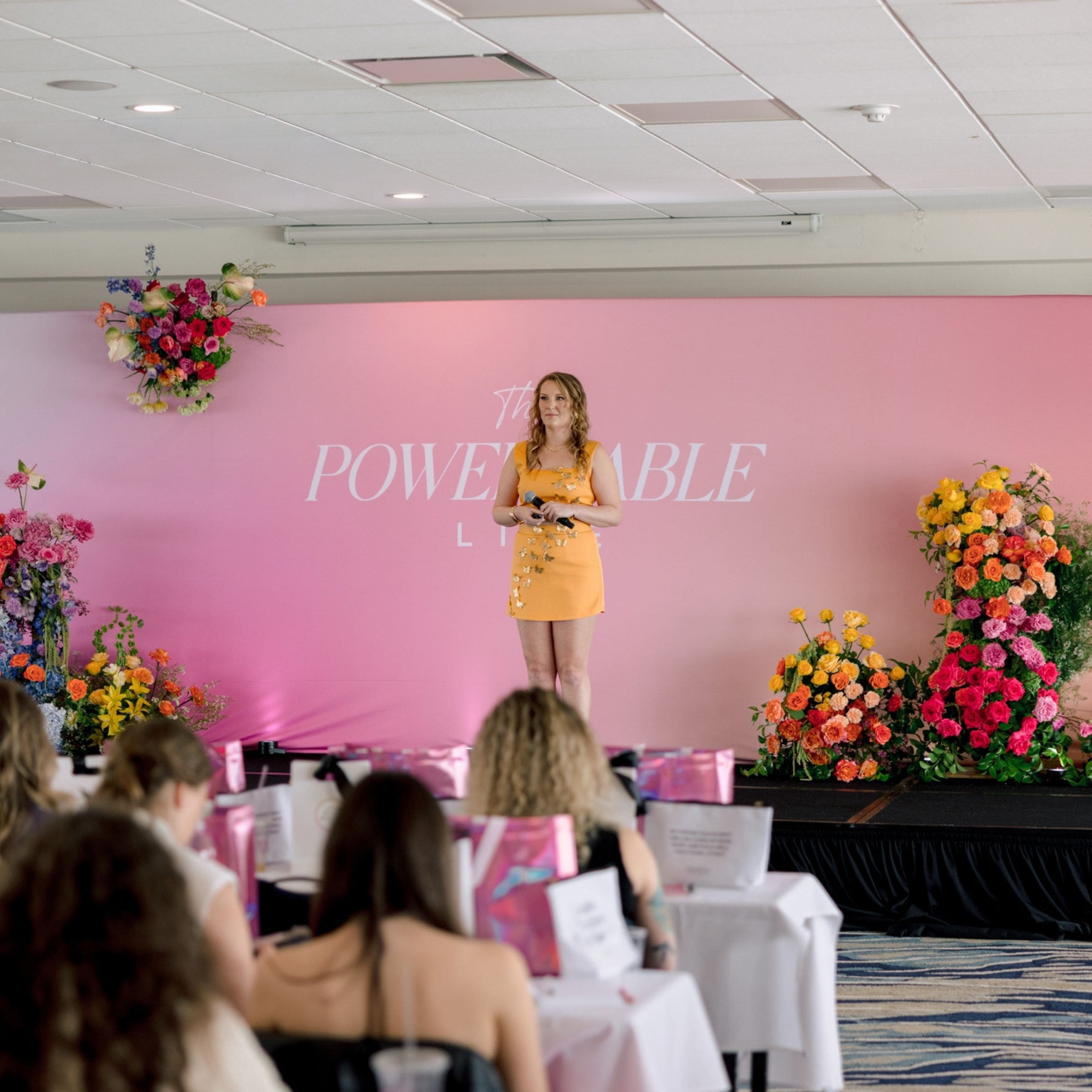


Most people think the goal is to get better at pitching.
Better cold emails or DMs.
Better speaking topics.
Better speaker applications.
And while those things matter, they’re not what typically gets most people their first speaking or podcast guesting opportunity.
Because the truth is—most stages, podcasts, and collaborations don’t come from perfectly crafted pitches.
They come from being easy to say yes to.
I learned this the hard way.
In 2023, I spoke on zero stages.
I hosted my first event—and no one came.
The following year, I spoke on 4 stages and went on about 20 podcasts.
The year after that, I spoke on 65 virtual and in-person stages and podcasts.
And here’s what’s interesting:
The majority of those opportunities? I didn’t pitch for.
Which forced me to ask a different question.
Not: How do I get chosen?
But: What makes someone choosable in the first place?
Because once you understand that, everything changes.
The Real Goal: Become an Easy Yes
When an event host or podcast host is deciding who to bring onto their show or stage, they are not necessarily looking for the most qualified person.
They are looking for the least risky, most aligned, most certain choice.
That means:
- They understand exactly what you would talk about
- They trust that you can deliver
- They feel confident their audience will benefit
- They don’t have to do extra work to figure you out
Most people make this harder than it needs to be.
They assume they need:
- A bigger audience
- More experience
- More credentials
But what they actually need is clarity, proof, and proximity.
Because the same things that make you easy to book also make you easier to hire.
Here’s how to build that.
1. Make It Obvious What You Would Speak About
One of the biggest mistakes I see is vague expertise.
Someone says they talk about business, growth, mindset, or marketing—which might all be true—but none of it is specific enough to book.
This often shows up like, “Helping women feel more confident.”
Or, “Helping high achieving entrepreneurs get the results they want through executive coaching.”
Okay…but it’s very hard to figure out what that actually means.
Because when a host is thinking about their next guest or speaker, they are not asking:
“Who knows about business?”
“Who helps with confidence?”
“Who helps people get results?”
They are usually asking:
“Who can speak on this specific topic for this specific audience that I’ve already seen before?”
If they have to guess what you would talk about, they will move on to someone who is clearer.
This is why your first step is not pitching—it’s positioning.
You should be able to clearly articulate what you speak on in a way that feels immediate and obvious. Not a long explanation. Not a list of everything you could cover.
Something that makes someone instantly think:
“She would be perfect for this.”
2. Create Proof Before You’re Asked For It
Another common misconception is that you need to be booked before you can prove you’re ready.
In reality, it works the opposite way.
You create proof first—so that when the opportunity comes, the decision is easy.
This doesn’t mean you need a long list of stages.
It means you need visible evidence of your thinking and delivery.
That could be through teaching a concept, breaking down your ideas in long-form content, or creating spaces where people can experience how you think.
You should have clear, high quality photos and video content of you speaking or teaching on your social media and website.
Because when someone is considering you, they are not imagining what you might be like.
They are looking for signals of what you are already doing.
The more visible your proof, the less they have to assume.
And the less they have to assume, the easier it is to say yes.
3. Get in the Rooms Where Opportunities Happen
Most people are trying to access opportunities from the outside.
They’re sending cold pitches, submitting applications, and hoping to be discovered.
But many of the best opportunities are never posted.
They happen in conversations.
In rooms.
In communities.
At dinners.
In proximity to the people making decisions.
This is something I didn’t fully understand early on.
I thought if I just kept showing up online, the right people would find me.
But it wasn’t until I started intentionally putting myself in rooms—events, communities, collaborations—that things shifted.
Because now:
- People knew who I was
- They had experienced my thinking
- They had context for where I fit
And when opportunities came up, my name was already in the conversation.
You don’t need to be everywhere.
But you do need to be where it matters.
4. Build Relationships Before You Need Them
Most people start trying to build relationships when they need something.
When they want to be booked.
When they want an introduction.
When they want an opportunity.
But relationships don’t work on demand.
They work on familiarity and trust over time.
The people who get invited into opportunities consistently are not always the most visible.
They are the most connected.
They stay in conversation.
They engage with others’ work.
They support and collaborate.
So when the moment comes, it’s not:
“Who should we bring in?”
It’s:
“Oh—we should ask her.”
That shift—from being unknown to being top of mind—is what changes everything.
5. Position Yourself as Someone Who Already Belongs
This is the most subtle—but most important—shift.
Many people approach opportunities from a place of:
“I hope they give me a chance.”
And that energy shows up in how they:
- Talk about their work
- Describe their experience
- Position themselves in conversations
But decision-makers are not looking for someone to “give a chance” to.
They are looking for someone who already feels like they belong in the room.
That doesn’t mean you need years of experience.
It means you need to:
- Speak clearly about what you do in your own content
- Own your perspective
- Show up as someone who is already doing the work
Because confidence, when grounded in clarity and proof, reads as readiness.
And readiness is what gets you chosen.
The Bigger Shift Most People Miss
If you take a step back, none of this is about pitching more.
It’s about becoming more obvious.
More clear.
More visible in the right ways.
More connected.
More aligned with the opportunities you want.
Because when those things are in place, something changes.
You don’t have to convince people as much.
They already see it.
And over time, the dynamic shifts from:
“How do I get booked?”
To:
“How do I manage the opportunities coming my way?”
Where to Start
If you’re looking to land your first speaking or podcast opportunity, don’t start with outreach.
Start with your foundation.
Ask yourself:
If someone found me today, would it be obvious what they could book me for?
Is there visible proof of how I think and teach?
Am I in rooms where these opportunities exist?
Do people know me well enough to recommend me?
Because the fastest way to get your first yes…
Is to become someone who already looks like the obvious choice.
The Bottom Line
You don’t need more pitches.
You need stronger positioning.
Because once you become easy to say yes to, you stop chasing opportunities,
and start being properly positioned for them.
I’m Taylor Smith
Welcome to a space where personal branding meets personal development. Here, you’ll find insights, strategies, and a dose of inspiration to help you stand out, own the stage, and lead with confidence.


Read the Article
5 Ways to Land Your First Speaking or Podcast Opportunity
read the article

Join My Mastermind
Ready to Stand Out Online?
Let’s work together to build your business's visibility & scale inside The Power Table Mastermind.


