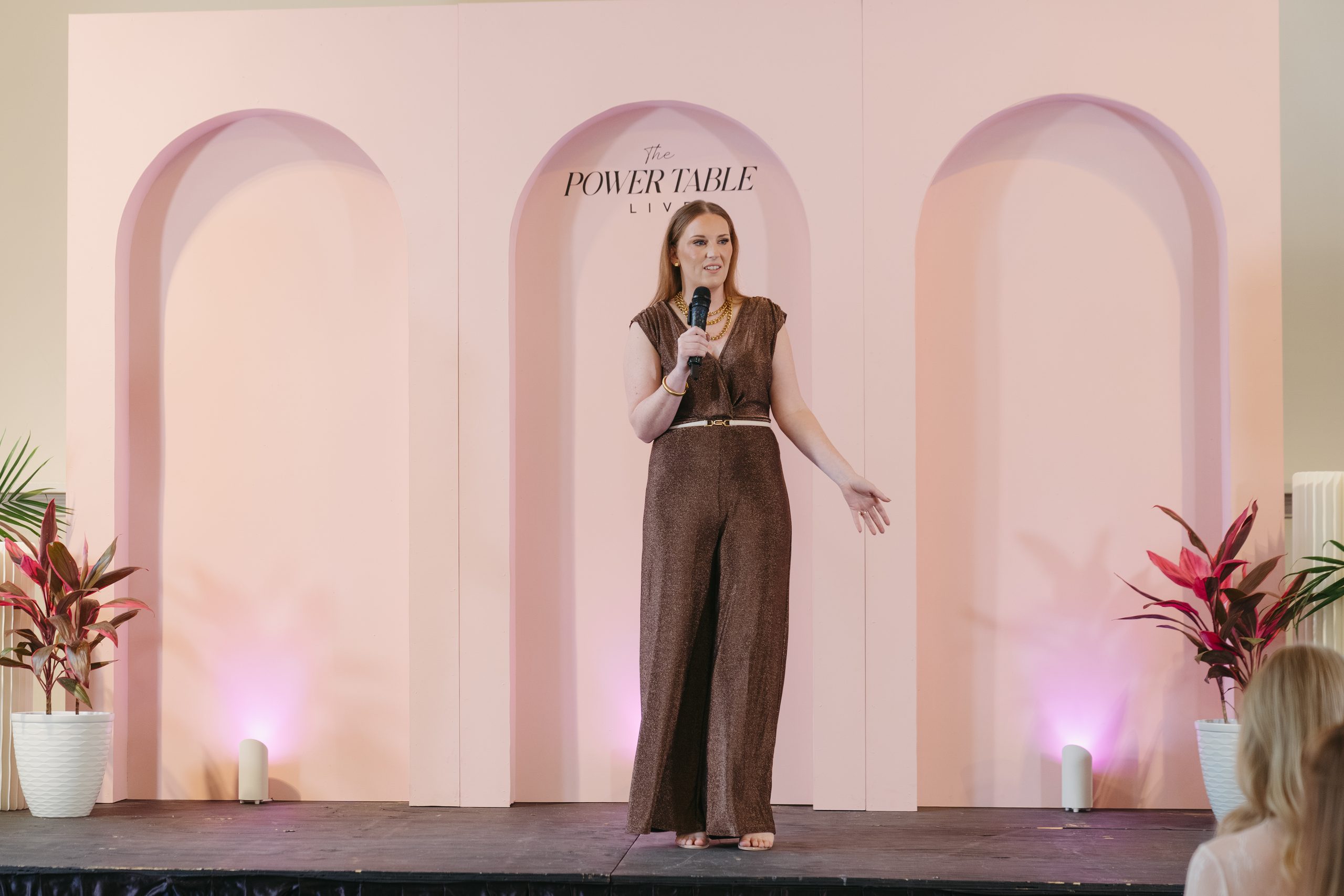


This is Article 11 of the Female Founder Economy series.
In this series, I define and document the Female Founder Economy: the goals, priorities, revenue models, and growth patterns of entrepreneurial women who are building their companies primarily online. Topics explored across the series include, but are not limited to, visibility, leadership, team and scale, revenue and economic impact, emotional and mental well-being, relationship capital, and AI.
Solo by Design: Why Some of the Most Strategic Founders Are Choosing Lean Businesses
People are always surprised by the small size of my team.
They see The Power Table podcast, the live conference, the community, and the brand partnerships, and they assume there is a large staff behind it. Then they ask how many people I employ, and I watch their face change when I tell them. The question underneath is always the same. How do you do all of this with so few people?
The answer to “how big is your team” is often treated like a scoreboard. More employees means more success. A team of one is a hobby. If you are serious, you hire, and then you keep hiring. That belief is still everywhere, from other founders to the media to the brands sizing you up before a partnership.
The way we structure and build businesses now makes team size an almost meaningless metric, and a growing number of women have already figured that out.
There is a difference between solo by default and solo by design.
Solo by default is a founder who wants a team and cannot afford one yet.
Solo by design is a founder who could build a big team and chooses not to. That second group is the one I keep meeting. They run service-based businesses, agencies, coaching practices, and communities. They bring in contractors instead of building departments. And they are doing $200,000 to a million dollars a year on average with almost nothing in house.
The data backs up what I am seeing in my community. There are now 72.9 million independent workers in the country, and 5.6 million of them earn six figures on their own, up 19% in a single year. Solo businesses are growing more than twice as fast as businesses with employees, according to the Census Bureau, and they already generate $1.7 trillion. This is not a fringe model. It is one of the fastest growing parts of the economy, and particularly for women.
Here is how it actually works in my business.
I have a couple of full-time team members. Everything else runs on contractors, hired fractionally, for things like event coordination and logistics, facilitation, PR and media, content, community management, website, legal, and cybersecurity. I hire each of them because they are already excellent at the one thing I need. There is almost no training and very little management or oversight required from me. They stay in their zone of genius, and I stay in mine.
Three things made this possible in the last few years.
- AI and automations took a substantial amount of work off my plate.
- Fractional and contract roles went mainstream, so the best people are now available by the project instead of only by the salary.
- And the tools got good enough that a small operation can run like a big one.
But, the reason I choose it is not really about money. The cost of a big team was never just the payroll. It was going to be the mental space. A large team asks for your time, your attention, and your energy. It pulls you out of the work you are actually good at and into managing everyone else. It slows down decisions. It creates payroll pressure that pushes founders into choices they would not otherwise make.
I would rather check team messages once a day, show up for my clients, make my content, and then go play pickleball or cook a healthy dinner. Working with contractors and fractional partners removes the expectation that I am hovering. It also gives them something they want, which is autonomy and the room to set their own terms.
Solo by design becomes the standard, not the exception. We will see courses, masterminds, and communities built specifically for this kind of founder (in fact, this is who we serve primarily in The Power Table Mastermind and our greater community). And the status marker flips. The question stops being how big is your team and starts being how lean is your team. Solo by design becomes the new luxury.
If you are running a lean business right now and quietly wondering when people will stop expecting you to hire a “real team,” even though your business runs just fine without it, hear me clearly. You are not behind. You might be early. A small team is not a smaller version of a real company. For a lot of us, it is the smarter one.
Sources: MBO Partners, “2025 State of Independence in America”; U.S. Census Bureau, Nonemployer Business Statistics
This is Article 11 in the Female Founder Economy series.
I write this series from what I see firsthand: the rooms, the private conversations, and the businesses women are actually building. The entire article series can be found on my website, www.taylorsmithonline.com
For media inquiries, interview requests, or speaking opportunities, use the contact form on my website or reach me directly at taylor@taylorsmithonline.com.
I’m Taylor Smith
Welcome to a space where personal branding meets personal development. Here, you’ll find insights, strategies, and a dose of inspiration to help you stand out, own the stage, and lead with confidence.


Read the Article
5 Ways to Land Your First Speaking or Podcast Opportunity
read the article

Join My Mastermind
Ready to Stand Out Online?
Let’s work together to build your business's visibility & scale inside The Power Table Mastermind.


